Original practice questions from all six chapters of the CTFL v4.0 syllabus, at every K-level, with the answer and a full explanation for each. They come from the same bank as simul8R’s full practice exams.
Try each question before you open the answer. On the real exam you’d have about 1.5 minutes per question. For the full experience, timed and on the same screen as your exam provider, take a free practice exam on simul8R. To understand the exam itself, read the CTFL 4.0 exam guide.
Question 1Chapter 1: Fundamentals of testingFL-1.2.2 · K1
Which term describes a product-oriented, corrective approach that focuses on activities supporting the achievement of appropriate levels of quality?
Quality assurance
Root cause analysis
Quality control
Process improvement
Show the answer
Answer: C. Quality control (QC) is the product-oriented, corrective approach, and testing is a major form of QC (Syllabus 1.2.2). Quality assurance is process-oriented and preventive, root cause analysis identifies the fundamental reasons for problems (Syllabus 1.2.3), and process improvement is a QA concern rather than a product-oriented one.
Question 2Chapter 1: Fundamentals of testingFL-1.1.2 · K2
A tester reports a failure in an airline check-in kiosk. A developer reproduces it, diagnoses it and fixes the cause.
What should happen next, according to the syllabus?
The developer closes the defect report, because reproducing, diagnosing and fixing the cause completes all the work needed
The tester debugs the fix again to identify its root cause before the test manager closes the defect report
Nothing further, because debugging already includes checking that the fix works and has not broken other parts of the system
Confirmation testing, preferably by the person who ran the initial test, and regression testing to check for failures elsewhere
Show the answer
Answer: D. After debugging, confirmation testing checks whether the fix resolved the problem, preferably performed by the same person who performed the initial test, and regression testing checks whether the fix causes failures in other parts of the test object (Syllabus 1.1.2). Closing the report without testing, having the tester diagnose the fix, or assuming debugging covers the rest of the system are all incorrect.
Question 3Chapter 2: Testing throughout the SDLCFL-2.1.2 · K1
In a smart-home IoT project, the firmware design phase was completed without any test activity being planned or performed for it. Which good testing practice was NOT followed?
Different test levels have specific and different test objectives
Testing is carried out by people independent of the developers who wrote the firmware
Regression tests are automated in a delivery pipeline and run on every firmware build
For every software development activity there is a corresponding test activity
Show the answer
Answer: D. The good practice that every software development activity has a corresponding test activity was missed, because the design phase had no test activity and so was not subject to quality control (Syllabus 2.1.2). Distinct objectives for test levels concern how levels relate to each other, while test independence and automated regression in a pipeline are not among the good practices listed in 2.1.2.
Question 4Chapter 2: Testing throughout the SDLCFL-2.1.1 · K2
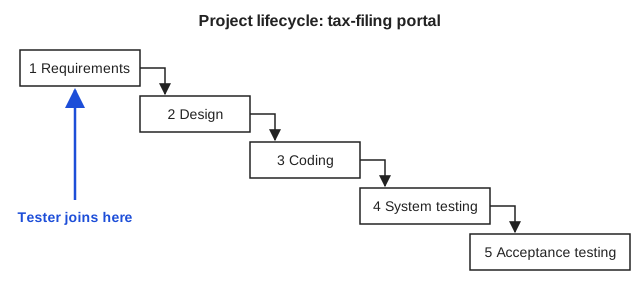
The diagram shows the sequential lifecycle planned for a government tax-filing portal. A tester is assigned to the project at the point marked in the diagram. Which activity can the tester most usefully perform at that point?
Executing system test cases against the first build of the portal in the test environment
Running automated regression tests on each nightly build
Reviewing the requirements and beginning test analysis and test design
Performing exploratory test sessions on the portal user interface
Show the answer
Answer: C. In a sequential model, testers in the initial phases participate in requirements reviews, test analysis and test design, while executable code is only created in later phases (Syllabus 2.1.1). The tester joins during step 1, Requirements, before step 3, Coding, so no build exists yet. Executing system tests, running regression tests on builds and exploratory sessions on the user interface are all dynamic testing, which needs executable code.
Question 5Chapter 3: Static testingFL-3.1.2 · K2
A project manager wants to drop the planned reviews of the requirements and design because "reviews just add cost". Which argument for keeping them is consistent with the syllabus?
Reviews make dynamic testing unnecessary for any work product that has been reviewed
Reviews are cheaper than dynamic testing in every situation and need no preparation time
Reviews reliably detect performance failures before any code has been written
Reviews cost effort, but overall costs are usually lower because early fixes are cheaper
Show the answer
Answer: D. Static testing detects defects in the earliest phases of the SDLC, and fixing them then is cheaper than fixing them later; although reviews can be costly to implement, overall project costs are usually much lower (Syllabus 3.1.2). Static testing complements dynamic testing rather than replacing it, and performance failures are found by executing the software.
Question 6Chapter 4: Test analysis and designFL-4.1.1 · K2
A team wants to derive test cases with a white-box test technique. Which of the following is the most typical test basis for this?
A use case describing the interaction between an actor and the system
The source code and detailed design of the test object
A list of failures that occurred in similar applications in the past
The acceptance criteria agreed for a user story
Show the answer
Answer: B. White-box test techniques are based on an analysis of the internal structure and processing of the test object, such as code, architecture, detailed design or control flow (Syllabus 4.1). Use cases and acceptance criteria are typical bases for black-box techniques, and lists of past failures support experience-based techniques such as error guessing.
Question 7Chapter 4: Test analysis and designFL-4.2.2 · K3
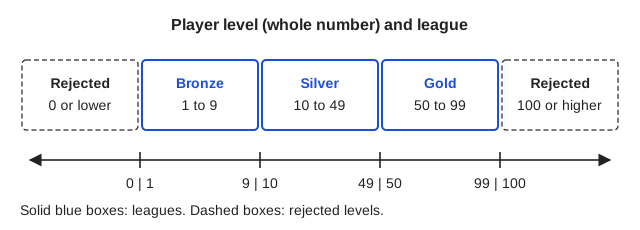
A game server accepts a player level, entered as a whole number, and assigns a league as shown in the exhibit. Tests have been executed with the levels 1, 5, 10, 49, 99 and 100.
What 2-value boundary value coverage has been achieved?
50%
62.5%
75%
83%
Show the answer
Answer: B. The boundary values are 0 (maximum of the lower rejected partition), 1 and 9 (Bronze), 10 and 49 (Silver), 50 and 99 (Gold) and 100 (minimum of the upper rejected partition); each one's closest neighbour is itself a boundary value, so there are 8 coverage items (Syllabus 4.2.2). The tests hit 1, 10, 49, 99 and 100, while 5 is not a boundary value: 5 / 8 = 62.5%. 83% divides 5 by the 6 tests, 75% counts 5 as a covered item and 50% misses an exercised boundary.
Question 8Chapter 4: Test analysis and designFL-4.2.1 · K3
An insurance application accepts the applicant's age as a whole number. Ages from 18 to 75 inclusive are accepted; all other ages are rejected. Accepted ages are priced in three bands: 18 to 25: young driver rate 26 to 60: standard rate 61 to 75: senior rate
Which set of test inputs achieves 100% equivalence partition coverage?
10, 22, 45, 70, 80
17, 18, 60, 76
18, 25, 26, 60, 61, 75
0, 25, 61, 99
Show the answer
Answer: A. There are five partitions: below 18 (invalid), 18-25, 26-60, 61-75 (valid) and above 75 (invalid), and 10, 22, 45, 70 and 80 cover one value from each (Syllabus 4.2.1). The set 17, 18, 60, 76 misses the 61-75 partition, the set 18 to 75 covers only the three valid partitions, and 0, 25, 61, 99 misses the 26-60 partition.
Question 9Chapter 4: Test analysis and designFL-4.2.1 · K3
A multi-storey car park charges by parking duration in whole minutes: 0 to 30: free 31 to 120: $3 121 to 720: $8 721 to 1440: $15 (day rate) Above 1440: rejected; staff must check the vehicle
Tests have been executed with durations of 15, 30, 100 and 1500 minutes. Which TWO values must be added to achieve 100% equivalence partition coverage? (Select TWO)
120
600
1440
31
1441
Show the answer
Answer: B and C. There are five partitions; 15 and 30 cover "free", 100 covers $3 and 1500 covers "above 1440", so only the $8 partition (121-720) and the day-rate partition (721-1440) are missing (Syllabus 4.2.1). 600 is in the $8 partition and 1440 is in the day-rate partition. 120 and 31 are in the already covered $3 partition, and 1441 is in the already covered rejected partition.
Question 10Chapter 5: Managing the test activitiesFL-5.1.1 · K2
Which of the following would typically be included in the test plan for an electronic voting system?
The defect reports raised during the second test cycle
The test data requirements and the test environment requirements
The coverage actually achieved at the end of system testing
The progress figures reported at each daily stand-up meeting
Show the answer
Answer: B. Test data requirements and test environment requirements are part of the test approach described in a test plan (Syllabus 5.1.1). Defect reports, the coverage actually achieved and daily progress figures are produced during or after test execution and belong in defect reports, test progress reports and test completion reports, not in the plan.
Question 11Chapter 5: Managing the test activitiesFL-5.1.4 · K3
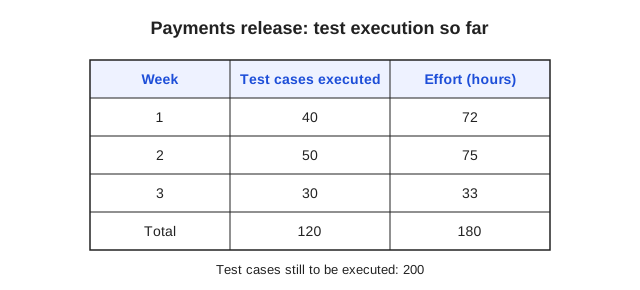
During the test execution of a bank's payments release, the test manager records the effort per week, as shown in the exhibit. To estimate the effort for the test cases still to be executed, she extrapolates using the average effort per test case so far (total effort divided by total number of test cases executed).
What is the estimated effort for the remaining test cases?
180 hours
220 hours
300 hours
360 hours
Show the answer
Answer: C. So far 180 hours were spent on 120 test cases, which is 1.5 hours per test case; for the remaining 200 test cases this gives 200 x 1.5 = 300 hours (Syllabus 5.1.4, estimation by extrapolation). 360 uses only the week 1 rate (72 / 40 = 1.8), 220 uses only the week 3 rate (33 / 30 = 1.1), and 180 just repeats the effort spent so far.
Question 12Chapter 6: Test toolsFL-6.2.1 · K1
A bank is building a business case for test automation. Which of the following can it correctly list as a benefit of test automation?
It removes the need for test analysis and test design by the testers on the project
It guarantees that the software contains no remaining defects at release to production
It gives more objective assessment, e.g. coverage, and measures too complex for humans to derive
It eliminates the effort of maintaining the automated test scripts as the software changes
Show the answer
Answer: C. More objective assessment, such as coverage, and measures that are too complicated for humans to derive are a listed benefit of test automation (Syllabus 6.2). Automation does not replace test analysis and design, testing cannot prove the absence of defects, and maintaining test scripts takes effort that is often underestimated, which is a listed risk.
Ready for a full 40-question exam?
A free practice exam is included. Every full exam follows the official ISTQB® blueprint (8/6/4/11/9/2 questions by chapter) on the Pearson VUE, Kryterion or iSQI screen, with explanations and readiness by chapter.
These are original questions written to the ISTQB® CTFL v4.0 syllabus, not official ISTQB® exam questions. ISTQB® is a registered trademark of the International Software Testing Qualifications Board.